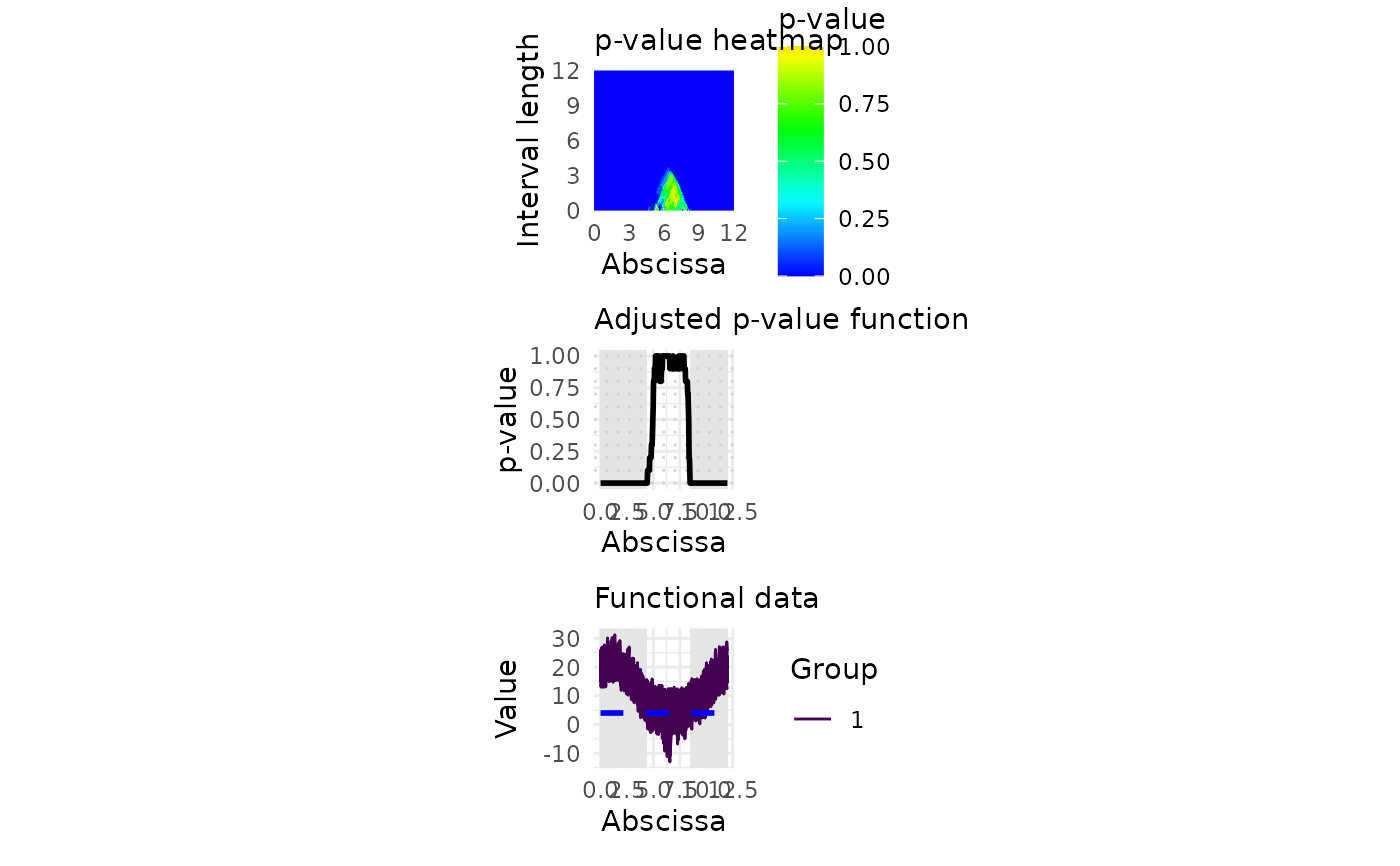
Plotting function creating a ggplot2 graphical output of the IWT: the p-value heat-map, the adjusted p-value function, and the functional data, assembled via patchwork.
Usage
IWTimage(
  IWT_result,
  alpha = 0.05,
  abscissa_range = c(0, 1),
  nlevel = 20L,
  plot_unadjusted = FALSE
)
Arguments
- IWT_result
Results of the IWT, as created by
functional_one_sample_test(),iwt1(),functional_two_sample_test(),iwt2(), or the legacy functionsIWT1()andIWTaov(). When usingfunctional_two_sample_test()oriwt2(),correctionmust be"IWT".- alpha
Threshold for the interval-wise error rate used for the hypothesis test. Regions where the adjusted p-value is below
alphaare highlighted. The default isalpha = 0.05.- abscissa_range
Range of the plot abscissa. The default is
c(0, 1).- nlevel
Number of desired color levels for the p-value heatmap. The default is
nlevel = 20.- plot_unadjusted
Flag indicating if the unadjusted p-value function has to be overlaid (dashed line) on the adjusted p-value panel. The default is
FALSE.
Value
An object of class patchwork containing the assembled ggplot2
panels, returned invisibly. The plot is also printed as a side effect.
References
Pini, A., & Vantini, S. (2018). Interval-wise testing for functional data. Journal of Nonparametric Statistics, 29(2), 407-424.
Pini, A., Vantini, S., Colosimo, B. M., & Grasso, M. (2018). Domain‐selective functional analysis of variance for supervised statistical profile monitoring of signal data. Journal of the Royal Statistical Society: Series C (Applied Statistics) 67(1), 55-81.
Abramowicz, K., Hager, C. K., Pini, A., Schelin, L., Sjostedt de Luna, S., & Vantini, S. (2018). Nonparametric inference for functional‐on‐scalar linear models applied to knee kinematic hop data after injury of the anterior cruciate ligament. Scandinavian Journal of Statistics 45(4), 1036-1061.
See also
See plot.fos(), plot.fts(), plot.flm() and
plot.faov() for the plot method applied to the IWT results of one-
and two-population tests, linear models, and ANOVA, respectively.
Examples
# Performing the IWT for one population
IWT_result <- functional_one_sample_test(
NASAtemp$paris, mu = 4, n_perm = 10L
)
# Plotting the results of the IWT
IWTimage(IWT_result, abscissa_range = c(0, 12))
 # Selecting the significant components at 5% level
which(IWT_result$adjusted_pvalues < 0.05)
#> [1] 1 2 3 4 5 6 7 8 9 10 11 12 13 14 15 16 17 18
#> [19] 19 20 21 22 23 24 25 26 27 28 29 30 31 32 33 34 35 36
#> [37] 37 38 39 40 41 42 43 44 45 46 47 48 49 50 51 52 53 54
#> [55] 55 56 57 58 59 60 61 62 63 64 65 66 67 68 69 70 71 72
#> [73] 73 74 75 76 77 78 79 80 81 82 83 84 85 86 87 88 89 90
#> [91] 91 92 93 94 95 96 97 98 99 100 101 102 103 104 105 106 107 108
#> [109] 109 110 111 112 113 114 115 116 117 118 119 120 121 122 123 124 125 126
#> [127] 127 128 129 130 131 132 133 134 135 258 259 260 261 262 263 264 265 266
#> [145] 267 268 269 270 271 272 273 274 275 276 277 278 279 280 281 282 283 284
#> [163] 285 286 287 288 289 290 291 292 293 294 295 296 297 298 299 300 301 302
#> [181] 303 304 305 306 307 308 309 310 311 312 313 314 315 316 317 318 319 320
#> [199] 321 322 323 324 325 326 327 328 329 330 331 332 333 334 335 336 337 338
#> [217] 339 340 341 342 343 344 345 346 347 348 349 350 351 352 353 354 355 356
#> [235] 357 358 359 360 361 362 363 364 365
# Selecting the significant components at 5% level
which(IWT_result$adjusted_pvalues < 0.05)
#> [1] 1 2 3 4 5 6 7 8 9 10 11 12 13 14 15 16 17 18
#> [19] 19 20 21 22 23 24 25 26 27 28 29 30 31 32 33 34 35 36
#> [37] 37 38 39 40 41 42 43 44 45 46 47 48 49 50 51 52 53 54
#> [55] 55 56 57 58 59 60 61 62 63 64 65 66 67 68 69 70 71 72
#> [73] 73 74 75 76 77 78 79 80 81 82 83 84 85 86 87 88 89 90
#> [91] 91 92 93 94 95 96 97 98 99 100 101 102 103 104 105 106 107 108
#> [109] 109 110 111 112 113 114 115 116 117 118 119 120 121 122 123 124 125 126
#> [127] 127 128 129 130 131 132 133 134 135 258 259 260 261 262 263 264 265 266
#> [145] 267 268 269 270 271 272 273 274 275 276 277 278 279 280 281 282 283 284
#> [163] 285 286 287 288 289 290 291 292 293 294 295 296 297 298 299 300 301 302
#> [181] 303 304 305 306 307 308 309 310 311 312 313 314 315 316 317 318 319 320
#> [199] 321 322 323 324 325 326 327 328 329 330 331 332 333 334 335 336 337 338
#> [217] 339 340 341 342 343 344 345 346 347 348 349 350 351 352 353 354 355 356
#> [235] 357 358 359 360 361 362 363 364 365